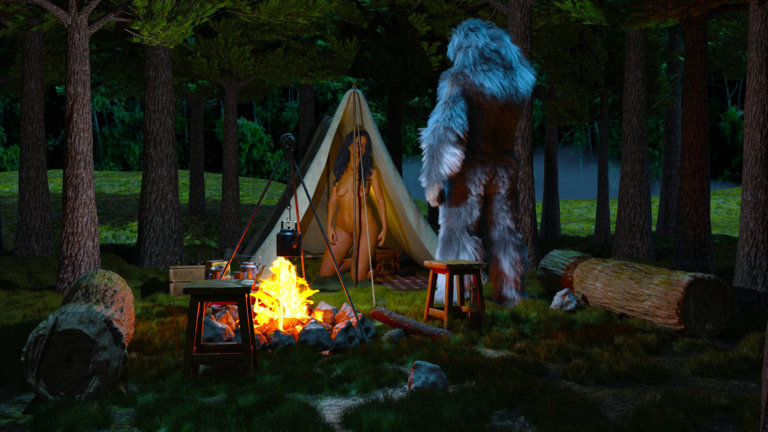
I am Elena Thornwood, a cryptozoologist who specializes in Sasquatch research. I hunt for Bigfoot and this is my story.
The campfire crackled, throwing long shadows against the towering moss-covered Douglas firs of the Olympic National Forest. I zipped my tent flap halfway, settling onto the sleeping bag with a book. The deep, primeval silence of the Pacific Northwest woods always brought me peace.
Then, the forest went dead silent. The nocturnal hum of insects and distant frogs instantly vanished. A wave of heat hit the tent, followed by a stench so foul it made my eyes water. It smelled like rotten garbage mixed with wet dog and sulfur. Heavy, ground-shaking thuds approached.
Thud.
Thud.
Thud.
I stood still, naked, my heart pounding against my ribcage. I reached blindly for the bear spray. A massive shadow blocked the moonlight filtering through the tent rainfly. Standing directly outside my tent was a silhouette so tall its torso eclipsed my entire field of view. The creature exhaled—a deep, rumbling growl that vibrated right through the forest floor and into my chest. Through the mesh of the partially zipped door, I saw it.
It stood at least eight feet tall, its massive frame covered in matted, dark brown hair that blended perfectly with the night. Its shoulders were incredibly wide, with virtually no neck. Two large, glowing amber eyes locked directly onto mine.
Knowing I couldn’t outrun it. I remembered the lore: wild animals fear fire and sudden chaos.
Summoning every ounce of courage, I grabbed my metal water bottle, smashed it repeatedly against the camp stove, and screamed at the top of my lungs.
The loud, metallic clanging reverberated forcefully among the trees. The creature recoiled, letting out a deafening, high-pitched screech that sounded like a cross between a freight train brake and a human scream. It took two massive, sweeping steps backward, vanishing into the dense underbrush with unbelievable speed.
I sat in the dark, clutching the bear spray until dawn, listening to the distant, heavy snapping of branches fading into the mountains.
The morning light revealed a chaotic scene around the campsite. Stepping onto the damp moss, my body aching from the night’s tension, I begin documenting the physical reality of what I saw.
Near the tent’s edge, there was a massive depression in the mud. It is nearly 18 inches long, shows distinct toe impressions, and has a stride length that no human could make.
Snagged on a sharp branch of a Douglas fir, roughly seven feet off the ground, hangs a thick clump of coarse, reddish-brown hair. It does not match the texture of a bear or elk. Immense physical strength snapped several thick tree limbs above the footprint, parting the brush.
I capture images of the prints using my phone, and I observed an element that contradicts the conventional narrative. Within the profound heel indentation of the largest footprint lies a broken fragment of aged, corroded metal.
Kneeling, I carefully pry it from the mud. It is not a modern relic. It appears to be a heavy, hand-forged iron medallion engraved with strange, geometric symbols—and it looks incredibly old. The creature wasn’t just wandering; it was carrying this, or stepped directly on something buried deep beneath the forest floor for centuries.
I track the heavy broken branches, plunging deeper into the uncharted ridges of the Olympic Mountains. The creature’s path is shockingly easy to follow. Its sheer size left a trail of destruction that cuts straight through the dense underbrush, leading me higher up the steep, misty ridges.
Sap oozes from recently broken fir branches positioned eight feet above the ground. In a high-elevation bog, I find another deep footprint, but this time, the mud is stained with a dark, thick fluid. The creature is bleeding from its frantic escape. The deeper I climb, the quieter the forest becomes. Even the wind seemed to die down as I approached a jagged, rocky ravine.
At the base of a sheer rock wall, the trail abruptly ends. Tucked into the shadows of the ravine is a massive, deliberate structure. It is a crude lean-to made of fallen old-growth logs, woven together with thick layers of moss and ferns to completely hide the entrance.
I creep closer, my pulse racing. Resting on a flat stone right outside the structure’s opening is a pile of ancient, rusted metal objects—identical in craftsmanship to the iron medallion in my pocket. Among them is a heavily weathered, leather-bound journal wrapped in oiled cloth, completely untouched by the damp mountain air.
I cautiously enter the completely dark structure, putting everything on the line to confront the being. The air inside is thick with the scent of damp earth, copper, and pine. As my vision acclimates to the dimness, I come to understand that the edifice is significantly more expansive than it seemed from the exterior, reaching deep into a natural cave crevice.
A massive bed of woven ferns and cedar bark occupies the center of the space, still radiating a faint, residual warmth. Drops of thick, dark blood lead past the nest and disappear into a narrow, downward-sloping tunnel at the back of the cave.
Engraved deeply into the stone walls are geometric designs that correspond precisely with the symbols found on my iron medallion. They aren’t random claw marks; they are a written language.
A soft, ragged wheeze echoes from the depths of the narrow tunnel. I freeze. Two glowing amber eyes blink open in the darkness just twenty feet away. The creature crouches, nursing a deep leg gash from its frantic night run. It doesn’t roar or attack.
Instead, it lets out a low, mournful whine that sounds startlingly vulnerable. It fixes its gaze on me, then shifts its eyes down to my hand, where I’m still holding the ancient iron medallion. The creature slowly extends a massive, hair-covered hand toward me, palm open, as if making a request.
I step forward into the dim cave, my hand trembling as I extend the ancient iron medallion toward the massive, open palm.
The creature’s hand is enormous, easily twice the size of my own, with thick, leathery skin beneath its dark hair. It moves with surprising gentleness, carefully pinching the small medallion with its massive fingers so it doesn’t scratch me.
As its fingers brush against mine, a strange sensation ripples through me—not of fear, but of profound, ancient sadness. The creature presses the medallion directly against the bleeding gash on its leg. The symbols glow with a faint, brief warmth, and the heavy bleeding immediately slows to a stop.
The entity emits a deep, resonating rumble that heats the chilly air within the cave. It looks deeply into my eyes, nods its massive head once, and reaches into the shadows of its nest.
The creature places a small, polished stone cylinder into my hand. It features a carved map of the Olympic Mountain ridges that points to a higher location on the peaks—a place marked with a symbol of a doorway.
With astonishing swiftness and utter quietness, the giant rises, glides past me into the dazzling morning brightness of the ravine, and disappears into the thick woods, leaving me entirely solitary yet secure.
I step back into the crisp morning air, holding the stone cylinder tightly, and snatch the weathered leather journal from the flat rock outside. Sitting on a fallen log a safe distance from the den, I lay both items across my lap to unravel the connection between them.
By cross-referencing the carvings on the stone cylinder with the handwritten entries in the journal, the pieces of a centuries-old puzzle instantly fall into place.
The book was owned by an early Spanish explorer from the 1790s, Captain Bruno de Hezeta, who documented his encounters with what he referred to as “Los Guardianes de la Tierra” (The Guardians of the Earth).
The journal explains that the iron medallions are not decorations. They are ancient, magnetic keys crafted by an unknown, pre-human civilization to lock down specific geothermal anomalies—or gateways—hidden in the mountains.
The stone cylinder’s map aligns perfectly with Hezeta’s final journal entries. It directly indicates the highest ice fields of Mount Olympus, specifically aiming at a concealed, underground vault that opens only when the stars are in alignment or when the correct keys are provided.
The creature didn’t just give me a map; it gave me a responsibility. The journal warns that losing the remaining keys will destroy the ancient gateways, triggering catastrophic tectonic shifts across the Pacific Northwest.
I made my way back to camp just as the sun dipped below the trees. With the campfire ablaze and the pot of water hanging over the flames, I went inside and stripped off my clothes.
Lying on my back on top of the sleeping bag with one hand caressing my tits and the other furiously rubbing my clit. My arousal was tenfold as I recalled Bigfoot’s very large, flaccid cock. It was by far the longest and thickest cock I’d ever seen. My mind filled with images of how it would look erect and feel.
My tongue instinctively caressed my lips as I imagined giving the creature a blow job. I drew closer to my release, and then it happened, it was the strongest orgasm I’ve ever experienced. The moans of pleasure emanating from my mouth were high-pitched whimpers and groans.
I lay there lingering in the afterglow, licking the sweet nectar from my fingers. When I heard a loud, familiar, deep rumbling growl. Startled, I jumped to my feet and stood inside the tent flap.
There was the creature, amber eyes open wide, cock fully erect and dripping precum. It lumbered slowly forward and, standing right in front of me, extended a muscular arm. I froze as a huge, long finger, which felt leathery and calloused, gently touched my pussy. I let out a sharp breath, which momentarily startled the creature.
I looked at the creature’s very solid vein-covered shaft, which was no less than a foot long. Reaching out, I realized my hand would not completely wrap around this beasthood. I took the thick rod in my hand around the thick rod, which appeared to be a foot long.
I started stroking the shaft, which felt to be just over a foot long. My pussy began to throb as the creature rubbed its finger along my wet slit. The creature and I were about to climax.
I pulled my hand away, and with what I can only describe as a look of bewilderment, the creature slipped its finger from my pussy.
It brought the nectar-covered digit to its nose and sniffed. Without hesitating, I stepped closer and rubbed my pussy against the solid shaft. To my surprise, the creature brought the digit to its mouth and licked up the sweet essence.
My rubbing against that foot-long shaft produced a steady flow of precum. I scooped some of the thick cream, licked my fingers clean as I turned around. Looking over my shoulder as I grasped the tent pole with my hands, I stuck out my butt and gave it a wiggle.
The creature was on me faster than you can say cum. The creature was jabbing me all around my butt with its beasthood. With one hand, I guided the tip of the tip to my pussy. With one forceful thrust, the beasthood was balls deep, and I let out a blood-curdling scream.
I was not expecting to be nearly split in half. Though, as we fucked, I was adjusting to having such a big thing inside me. The creature was pounding my pussy and emitting a chuffing sound while I moaned and groaned with each thrust.
The creature’s stamina was unbelievable, I had four mind-blowing orgasms before the beasthood filled me with its cum. There was so much that the thick cream flowed like a stream down my thighs and formed a pool on the tent floor.
With that last thrust reaching the pinnacle of my last orgasm, the creature was huffing deeply and purring like a cat. That’s the last I remember. Upon awakening the following morning, I found myself lying in a pool of semen, and the creature had vanished.
I pretty much hobbled down to the nearby stream. While I rinsed off, The feeling of being watched overwhelmed me while I rinsed off. I looked over at the treeline across the stream and saw two glowing amber eyes. I smiled, and they disappeared.
The distinct crack of snapping branches and the gentle, subtle rustle of parched leaves reverberated through the forest, indicating that the creature was departing.
Returning to camp, I came to realize the sexual encounter was one time experience. I packed up and made sure the embers of the campfire were thoroughly doused with water.
I hiked out of the deep wilderness, my mind racing with the secrets of the Spanish explorer’s journal and the stone cylinder. In less than forty-eight hours, I returned to civilization, utilizing every penny of my savings to get ready for a challenging, high-altitude journey across the glaciers of Mount Olympus.
I know the upper peaks of the Olympic Range are unforgiving, requiring specialized equipment to survive the terrain and document my findings.
I pack crampons, ice axes, climbing harnesses, and hundreds of feet of static rope to navigate the treacherous Blue Glacier. Acquiring a high-bandwidth satellite communicator along with a durable, military-grade GPS tablet to superimpose the ancient map of the stone cylinder onto contemporary topographic data is essential.
I carefully wrap the iron medallion and the stone cylinder in protective foam, packing them at the very center of her expedition pack.
One week later, I was standing at the snow-line of Mount Olympus. The thick rainforest lies far beneath, now substituted by a dazzling expanse of white ice, sharp rock crevices, and fierce winds.
Following the coordinate overlay on the GPS, I navigate past deep, bottomless crevasses. Reaching the precise high-altitude ridge indicated on the stone map, my satellite tablet suddenly glitches. The screen flickers violently, flashing the same geometric symbols engraved on my medallion.
Directly in front of me, revealed by a recent glacial thaw, stands a large, unusually smooth black stone archway that is embedded directly into the mountain peak. It is completely free of snow and ice, radiating a subtle, vibrating warmth.’
I step up to the massive, smooth black stone archway, my breath freezing in the biting alpine air. My hands shake slightly as I pull the iron medallion from my pack. Searching the dark stone surface, I find it: a perfectly carved, geometric indentation matching the artifact exactly.
Pressing the medallion into the slot. For a second, nothing happens. Then, a deep, resonant hum vibrates through the mountain peak, shaking the snow from the surrounding ridges. The geometric carvings on the archway glow with a brilliant, pulsing amber light, mirroring the eyes of the creature from the forest.
The seamless black stone divides down the center, sliding open with absolute silence to reveal a descending staircase illuminated by glowing, crystalline veins in the rock. Instead of freezing mountain air, a rush of warm, oxygen-rich air flows out from the interior, smelling of ancient stone and ozone.
I descend the stairs, leaving the blinding white glaciers of Mount Olympus behind. The stairs lead into a vast, subterranean chamber that defies modern science.
In the center of the cavern sits a massive, slowly rotating sphere made of the same dark metal as her medallion. Floating holos of the Earth’s tectonic plates hover around it, shifting slightly in real-time. I realize this entire facility is a stabilizing machine, built eons ago to keep the planet’s crust from tearing itself apart. The “Guardians” like the one she met aren’t just wild beasts; they are the ancient maintenance crew, genetically engineered to protect these vaults from outsiders and nature alike.
Suddenly, a massive shadow steps into the light on the far side of the rotating sphere. It is the same creature from the forest, its leg now completely healed. It doesn’t attack. It stands beside a secondary control console, looking from the console to me, waiting for me to take his place.
I step forward, leaving my climbing pack on the cavern floor. He approaches the secondary control console where the Guardian stands waiting. The interface consists of shifting geometric rings that match the symbols from the Spanish explorer’s journal. Together, we begin the repair process.
I open the 1790s leather journal, The Hezeta Expedition. I realize Captain de Hezeta hadn’t just witnessed the creature; he had documented the exact sequence of symbols required to reset the vault’s core during a previous tectonic crisis.
Guided by the journal’s sketches, I touch the glowing stone rings, rotating them to align with the shifting holographic map of the Pacific Northwest fault lines.
When a massive, jammed mechanical lever refuses to budge, the Guardian steps in. With a low rumble of effort, its immense physical strength forces the ancient mechanism back into place.
As the final ring clicks into position, the massive central sphere lets out a deep, harmonious chime. The erratic, flashing red indicators on the tectonic hologram instantly smooth out into a steady, calming amber glow.
The low-frequency vibrations that had been rattling the mountain dissipated. The Earth’s crust beneath the Pacific Northwest is secure once more. The Guardian looks down at me, its amber eyes softening. It places a massive hand over its chest in a universal gesture of gratitude, acknowledging me not as a trespasser, but as a true ally of the planet.
epilogue
Six months later, I sit in a bustling Seattle coffee shop, laptop open as I finish typing a mundane report for my day job as an environmental consultant. To anyone passing by, I’m just another professional working hybrid in the city. But beneath my sweater, hanging from a heavy cord around my neck, is the ancient iron medallion.
I established a precise, delicate rhythm to balance my two entirely different worlds:
From Monday to Thursday, I review civic zoning permits and timber reports. I use my professional access to subtly redirect commercial logging and mining operations away from the sensitive high-altitude zones of the Olympic Peninsula.
Every Friday night, I pack my high-tech alpine gear into my truck. Friends and family think I’m just an avid, borderline-obsessed weekend hiker. In reality, I’m making the grueling trek back up the ice fields of Mount Olympus.
I have digitized Captain de Hezeta’s 1790s journal into a secure, encrypted offline drive. I use it to monitor global seismic feeds, cross-referencing minor tremors with the ancient stabilization machine’s patterns.
On a crisp, foggy November evening, I stood at the tree line near my original campsite, miles away from the tourist trails. The air grows instantly still, and the familiar, deep silence falls over the woods.
A massive, eight-foot silhouette steps out from the shadows of the Douglas firs. The Guardian doesn’t approach my tent with aggression anymore. Instead, it places a heavy, moss-covered stone token at the edge of the clearing—a physical update showing that the subterranean vault’s core remains stable.
I nod, offering a small container of local berries and dried meats in return. The creature pauses, its amber eyes locking onto mine with a look of quiet, mutual respect, before it melts back into the dense underbrush without a sound. I smile, turning back toward the city lights in the distance. The world sleeps soundly, completely unaware of the duo keeping the very earth beneath their feet steady.
I hope you enjoyed reading “The Scent of the Primeval Woods.” Click on the heart if you liked the story. The star if you really liked it! Please leave a comment and I will respond to all.
Regards,
Banes1
The above story is a work of fiction. The names, characters, places, and events are products of the author’s imagination and are used as fantasy. Any resemblance to actual events or persons, living or dead, is entirely coincidental.
**
Copyright ©2026 All Rights Reserved. No part of this story may be reproduced or transmitted in any form or by any means, electronic, mechanical, photocopying, recording, or otherwise, without prior permission of the author, Banes1
